
Moving Target Defense by AmbiSure Technologies
Stop exploits at runtime. AmbiSure’s Moving Target Defense reduces ransomware risk, supports DPDP, RBI, SEBI CSCRF, IRDAI, and GxP needs. Request a demo today.
Overview
Stop Breaches Before They Start!
Disrupt attackers. Shrink risk. Prove resilience.
Indian enterprises face a wave of targeted ransomware and memory-based exploits. Traditional tools chase alerts and signatures. Attackers move faster.
Moving Target Defense (MTD) flips the game. It alters runtime targets in memory so exploits cannot find what they aim at. Prevention becomes default. Recovery becomes faster. Board confidence rises.
AmbiSure Technologies brings this capability to India with advisory, implementation, and 24×7 support. We help BFSI, Insurance, Pharma, and Manufacturing reduce breach likelihood and impact with speed and certainty.

The Challenge: Unseen Vulnerabilities
Ransomware downtime and revenue loss
Ransomware appears in a large share of breaches and drives long outages and payouts. Verizon’s DBIR highlights ransomware as a dominant factor in system intrusions.
Exploit chains that bypass EDR
Memory-based attacks dodge signatures and live off the land. You need deterministic prevention at runtime, not more alerts. Morphisec describes how morphing runtime memory breaks exploit reliability.
Regulatory pressure and penalties
India’s DPDP Act includes penalties up to ₹250 crore per violation. SEBI’s CSCRF tightens cybersecurity for capital market entities. RBI’s framework expects proactive resilience and timely incident reporting. IRDAI mandates strong cyber governance for insurers.
Board scrutiny on MTTD and MTTR
Boards ask for faster detection and response. Verizon DBIR trendlines and IBM’s report keep the spotlight on measurable outcomes.
Rising cost per breach in India
Recent coverage cites average breach costs in India at about ₹220 million. Cyber insurance deductibles and exclusions are also climbing.
IT operations overload and alert fatigue
Security teams drown in alerts. You need controls that prevent silently and reduce triage effort, not amplify it.
Skills and bandwidth gaps
Implementation needs trusted local expertise, process discipline, and rapid time to value. AmbiSure provides advisory, deployment, and ongoing support for large enterprises.
FEATURES
Technical and Functional Features That Matter
- Automated Moving Target Defense
Continuously reshapes runtime memory. Disorients exploits. Neutralizes zero-days and fileless attacks. Cuts dependence on signatures. - Adaptive Exposure Management
Continuously assesses your attack surface and exposure drivers. Prioritizes action before ransomware lands. - Ransomware Protection
Deterministic prevention halts encryption attempts. Blocks infiltration paths. Lowers outage risk and payout exposure. - Impact Protection
Prevents lateral movement and impact escalation. Minimizes blast radius when attackers probe systems. - Incident Response integration
Incident response workflows align with prevention telemetry. Faster containment and recovery. Evidence is ready for auditors and regulators. - EDR coexistence
MTD complements Microsoft and CrowdStrike deployments to reduce noise and improve prevention efficacy. - Low performance overhead
MTD runs efficiently at runtime. End users do not feel it. Ops teams do not chase tuning every week.
- Regulatory mapping pack
Controls and logs mapped to DPDP, RBI, SEBI CSCRF, IRDAI, and Pharma GxP expectations. Supports audit trails and board reporting. - Boardroom Justification Brief
One-page narrative with cost, risk, compliance impact, and timeline. Ready for the next Risk Committee. - Playbooks for Ransomware Crisis
Hour-by-hour steps for containment and recovery. Roles, communications, and regulator notifications aligned with sector guidelines. - Deployment in days
AmbiSure implements within a week for standard environments, aligned to your change windows.
- BFSI and Securities
Prevent ransomware in trading, payments, and core banking workloads. Provide evidence for RBI and SEBI inspections and cyber drills. - Insurance
Protect policy administration, claims, and underwriting platforms. Meet IRDAI cyber governance expectations. - Pharma and Manufacturing
Safeguard MES, LIMS, and validated systems. Protect data integrity under GxP and 21 CFR Part 11 expectations. Keep plants running.
business benefits
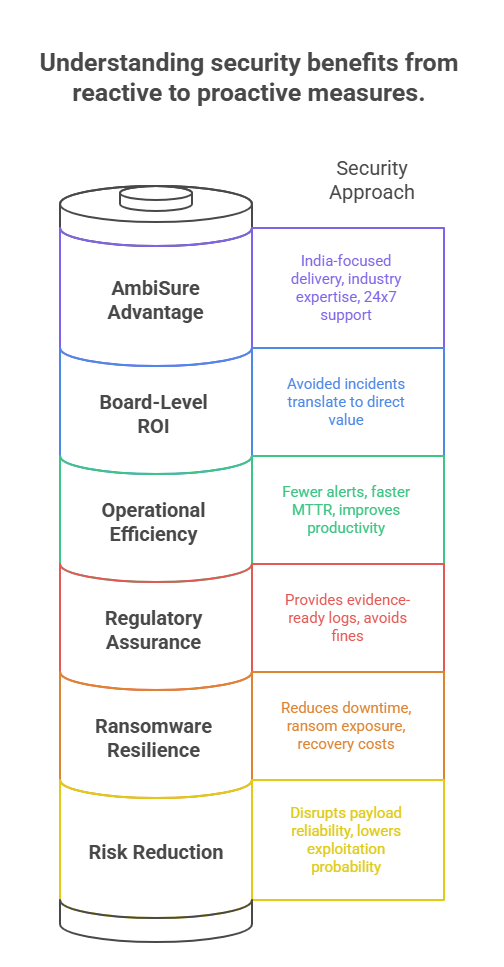
Breach Impact
A private sector bank sees initial ransomware beacons on trading desktops at 9.41 a.m. MTD blocks the memory exploit at load time. EDR shows no encryption activity. Trading continues. The CISO informs the board Risk Committee that controls prevented impact. Evidence aligns with RBI reporting templates.
A Pharma major spots anomalous behavior on a lab workstation. MTD prevents payload execution. QA confirms data integrity for ongoing validation lots. No deviation raised. Audit trail supports GxP and 21 CFR Part 11 expectations.
Cost of Delay
Higher breach probability as exploit kits evolve faster than signature tools.
Insurance pressures as carriers increase exclusions and premiums after incidents.
Regulatory penalties up to ₹250 crore per violation under DPDP for egregious failures
Board accountability when MTTD and MTTR do not improve despite spend.
Why Ambisure?

India-focused cybersecurity company with deep domain experience in BFSI, Pharma, Healthcare, and Manufacturing.

Consultative approach. Solution selection, audits, and managed support across 40+ cybersecurity offerings.

Rapid deployment within a week. 24x7 support. Proven with large enterprises that demand resilience and compliance.
WHAT OUR CLIENTS SAY
“MTD changed our ransomware posture in a week. We saw fewer noisy alerts and stronger prevention across trading desks and branches.”
— CISO, Large Private Bank
"The real-time monitoring and detailed insights & assurance have been invaluable in safeguarding our ope“Validation remained intact. Our lab and MES stayed online despite targeted exploit attempts. The board singled this out as a risk win.”rations."
— CTO, Top-5 Pharma Manufacturer
“Claim processing could not stop. MTD made that possible. The IRDAI audit was smooth with clear evidence of preventive controls.”
— CRO, General Insurer
frequently asked questions
How is MTD different from EDR or NGAV?
- EDR detects and responds. MTD prevents at runtime by morphing memory targets. Working together, EDR noise drops and true positives improve.
Where does MTD run?
- On Windows and Linux endpoints and servers. It shields critical apps without code changes.
What is the performance impact?
- Minimal. Runtime morphing is lightweight with no noticeable user impact in typical enterprise deployments.
Can it stop zero-days and fileless attacks?
- Yes. Exploits cannot find expected structures, so payload execution fails.
How does it support RBI, SEBI, IRDAI, and DPDP compliance?
- By providing preventive controls, auditable logs, incident workflows, and reporting artifacts aligned to sector frameworks and the DPDP Act.
What is the implementation timeline?
- AmbiSure implements within about a week post-sale for standard environments, with hardening and change control built in.
Does it work with Microsoft Defender or CrowdStrike?
- Yes. Coexists and enhances outcomes. Many firms run MTD with existing EDR for layered prevention
What evidence can I show the Board?
- Boardroom Justification Brief. Executive dashboards with prevented events, exposure trends, and projected loss avoidance using India breach cost benchmarks.
How does it help during an incident?
- Prevents impact, reduces lateral movement, and accelerates forensics with clear prevention logs and IR integrations.
Is it suitable for validated systems in Pharma?
- Yes. It protects runtime without changing application logic and supports data integrity expectations under GxP and 21 CFR Part 11.